
Councillors refused the 49.9MW Catherine de Barnes solar farm against officer advice, ruling the land is not grey belt. What the decision notice actually says.
Solihull councillors have refused a 49.9MW solar farm on green belt farmland, going against their own planning officers to do it. The scheme at Woodhouse Farm, Catherine de Barnes, was rejected at the Planning Committee on 24 July. The formal decision notice was issued on 30 July. (Decision notice, PL/2025/01404/PPFL, Solihull Council)
Officers had recommended approval. Their 58-page report to committee ended with a recommendation to grant permission subject to conditions and a section 106 agreement. (Report by the Head of Development Management, 24 July 2026)
What was proposed
The applicant of record is Castle Hills Solar Farm Ltd, with ADAS Planning acting as agent. The scheme covered land off Catherine de Barnes Lane, between the village, Bickenhill and the M42, immediately south of Birmingham Airport.
The application, as amended, proposed:
- a 49.9MW ground-mounted solar farm across 63.8 hectares, reduced during the application from 89.33 hectares
- a 5MW battery energy storage system
- 33kV and 132kV substations, transformers, inverters, control room containers and customer switchgear
- an internal access track, boundary fencing, CCTV and water tanks
- a design life of up to 40 years, after which the land would revert to agriculture
- a connection to the substation at Birmingham Airport
The applicant put the output at about 58.7 GWh of electricity a year. Officers recorded the claim that this would avoid roughly 7,500 tonnes of carbon dioxide a year at the current grid carbon intensity, and about 300,000 tonnes over the 40-year life.
The single reason for refusal
The decision notice gives one reason, and it turns on a phrase that will decide a lot of Solihull planning arguments over the next two years: grey belt.
The council concluded that Area 1 of the site, the land east of Bickenhill village, is not grey belt land “because it strongly contributes to Green Belt Purpose (a), namely checking the unrestricted sprawl of the Birmingham/Solihull built-up area”. The scheme was therefore inappropriate development in the green belt. The council was not satisfied that the very special circumstances put forward “clearly outweigh the harm to the Green Belt by reason of inappropriateness, together with the harm to openness and any other identified harms”.
That is the opposite of what the officer report concluded. Its executive summary opens with the line: “The proposal would utilise Grey Belt land as defined in the Framework and is not inappropriate development in the Green Belt.”
Grey belt is the category introduced by the revised National Planning Policy Framework in December 2024. It covers green belt land judged to make a weaker contribution to the green belt’s purposes, and national policy makes development there easier to justify. Solihull published its own updated assessment of that question on 28 July, four days after this vote, as we reported in our piece on the borough’s new green belt study.
What officers said in favour
The officer report gave “very substantial weight” to the renewable energy case. It leaned on the Climate Change Act 2008, the council’s own 2019 climate emergency declaration and the Clean Power 2030 Action Plan published in December 2024.
It also treated the timing as a benefit in its own right. The applicant held a grid connection offer for the second quarter of 2028, which officers said gave “a clear and timely pathway” to generating without further delay. Set against that, officers found the landscape harm “limited and localised” and expected it to reduce as planting matured.
The statutory consultees largely did not stand in the way. Birmingham Airport raised no objection. So did the Environment Agency, the Canal and River Trust and Historic England, each subject to conditions or mitigation. National Highways asked only for conditions.
Who objected
Two parish councils came out against it. Hampton in Arden Parish Council objected and asked for refusal, arguing the site does not qualify as grey belt, that it includes high-performing green belt, that it would take Grade 2 and Grade 3a “best and most versatile” farmland, and that the site choice looked driven by commercial proximity to Birmingham Airport rather than planning merit. Bickenhill and Marston Green Parish Council also recommended refusal on green belt grounds.
Public responses ran heavily against the scheme, then swung late. By the time the committee report was written the council had logged 50 responses: 44 objections, three neutral and three in support. The update note circulated for the meeting itself added six further objections and 38 further letters of support. (Planning Committee update note, 24 July 2026)
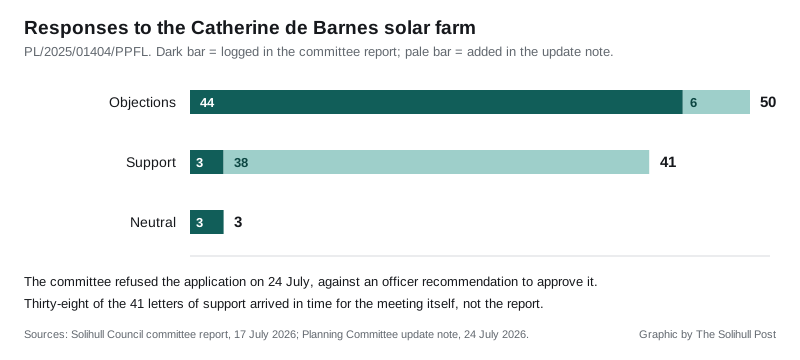
The most common objection themes recorded by officers were green belt harm, the loss of best and most versatile farmland, and doubt that restoring the land to agriculture after 40 years was, in the words of one response, “credible, nor enforceable”.
What happens next
Castle Hills Solar Farm Ltd can appeal to the Planning Inspectorate. For a refused application the deadline is six months from the date on the decision letter, which puts it at 30 January 2027. (How long you have to appeal, GOV.UK)
Minutes for the 24 July meeting had not been published on the council’s democracy site when we checked on 18 August, so we are not reporting a vote count.
Update, 15 September 2026: the printed minutes are now published. They record the application as “Refused, against officer recommendation” with the grey belt reason quoted above, but they do not record how councillors voted. Nine councillors were present. Speakers against were a member of the public, parish councillors Mike Kay (Bickenhill and Marston Green) and Dave Cuthbert (Hampton-in-Arden), and ward councillor Jane Lamden; two spoke in support. Councillor David Hoey declared he had observed a parish council meeting where the scheme was discussed, and said he had not pre-judged it.
The agenda and reports pack are on the meeting page, and the meeting itself was webcast and is listed on the council’s webcast portal.
Also live now: 45 panels at Chadwick End, comments close Thursday
A much smaller solar application in the borough is open for comment for two more days, and it has been widely described as a solar farm. It is not one.
The application at Chadwick Barns, Sparrow Cock Lane, Chadwick End proposes 45 ground-mounted panels in three rows of 15, for domestic use. The supporting statement gives the specification as 480W LONGi panels on a steel frame, with a footprint of about 17m by 11m, a maximum height of 2.2m and a 20.4kWh battery housed in an existing timber outbuilding. (Supporting statement, PL/2026/01224/PPFL)
That is about 21.6kW of capacity, on roughly 190 square metres. The refused Catherine de Barnes scheme was around 2,300 times larger.
It is still green belt, and it still drew consultee attention:
- West Midlands Police objected, on the grounds that the documents set out no security measures. Its design out crime officer noted the plans show Heras fencing “or equivalent” and said such fencing “does not provide any security”, recommending 2.4m weldmesh or paladin fencing and a CCTV scheme if permission is granted.
- The council’s heritage team raised no objection. Chadwick Barns is Grade II listed, and officers visited on 11 August. They concluded that because of distance, landscaping, topography and intervening buildings there is “no physical or visual relationship” between the listed building and the array.
- The Lead Local Flood Authority had no comments, finding no fluvial or surface water flood risk.
Consultation on the application closes on Thursday 20 August, and the council’s determination deadline is 16 September. The application papers are on the planning register under reference PL/2026/01224/PPFL.
What it means for you
If you live in Catherine de Barnes, Bickenhill, Hampton-in-Arden or Marston Green, this is not over. The applicant has until 30 January 2027 to appeal, and an inspector would then be free to reach a different view on the grey belt question than the committee did.
If you live anywhere else in the borough, the refusal matters for a different reason. It is the clearest signal yet that Solihull’s councillors are prepared to reject an officer recommendation over whether a piece of countryside counts as grey belt. That same argument will be run over and over as the draft Local Plan lands in autumn 2026, and over sites much closer to Knowle, Dorridge, Balsall Common and Shirley than this one.
And if you want to comment on the Chadwick End application, Thursday is the deadline. Our Solihull planning news page explains how to search the register and submit a comment, and sets out where the borough’s housing land supply arithmetic currently stands.
Have your say