
Solihull College reports a 92% T Level pass rate, and 100% in animal care, a course awarded for the first time this year. England's overall rate was 92.6%.
Solihull College & University Centre says its T Level students achieved a 92% pass rate this summer, with everyone taking the T Level in Animal Care & Management passing, a 100% pass rate in a course that had never been awarded anywhere in England before this year. (Solihull College & University Centre, 13 August 2026)
That puts the college a whisker below the national picture published the same morning. The Department for Education’s provisional figures show 18,218 of 19,665 students (92.6%) achieved a pass or above in their overall T Level across all 21 pathways, and 68.9% got a merit or above. (Provisional T Level results, academic year 2025/26, DfE, 13 August 2026)
The animal care result is the one worth pausing on. Animal Care and Management was one of three T Levels awarded for the first time this year, alongside Craft and Design and Media, Broadcast and Production, all of them first taught from September 2024. Nationally, 1,059 students took the animal care T Level and 92.3% passed, with 7.6% recorded as partial achievement. A full house at one college in a subject’s first year is a genuine result, not a rounding of one.
What a T Level actually is
T Levels are two-year courses taken after GCSEs, broadly the same size as three A levels, built with employers. Each one has a core component, an occupational specialism, and an industry placement of at least 315 hours, roughly 45 days with a real employer. (DfE)
Across England this year, 98.8% of students got an E or above in the core component, 95.4% passed their occupational specialism, and 97.2% completed the industry placement. The placement is the part that separates a T Level from a classroom qualification, and it is also the part that most often goes unfinished: in Digital Business Services, 11.7% of students had not completed a placement by 4 August.
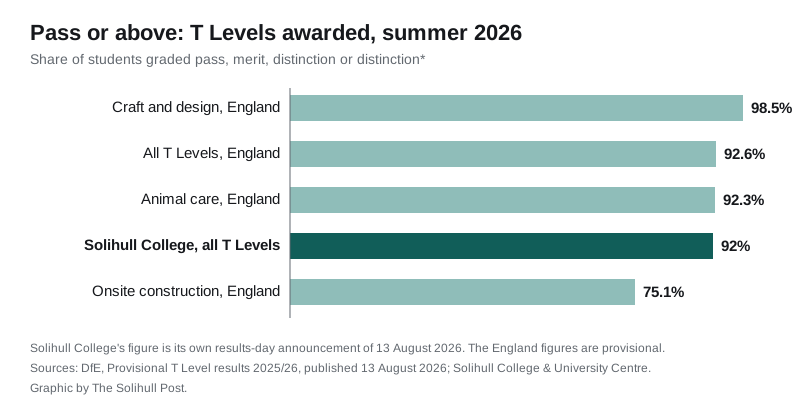
Pass rates vary enormously by subject, which is why a single college-wide number tells you less than it looks. This year the range ran from 98.5% in Craft and Design down to 75.1% in Onsite Construction.
The West Midlands numbers
T Levels are still growing fast. 2,610 students in the West Midlands received a T Level result this year, against 1,592 in the revised figures for 2024/25. Nationally the cohort went from 11,909 to 19,665, a rise of 65%, and the number of pathways went from 18 to 21.
The regional spread is lopsided. Education and Early Years is much the biggest T Level in the West Midlands with 629 students, followed by Health (376), Digital Production, Design and Development (256), Design and Development for Engineering and Manufacturing (240) and Design, Surveying and Planning (234). Only 82 students across the whole region took the new animal care T Level, and just five took Craft and Design.
The Solihull baseline, from the DfE’s own provider table
The college’s 92% is a provisional, in-house figure released on results day. The DfE also publishes results by individual provider, though a year behind and in revised form, and that table is the fairest baseline for what the borough’s providers have done before.
In the revised 2024/25 data, Solihull College & University Centre had 51 students with a T Level result across five pathways: Design, Surveying and Planning (7), Digital Production, Design and Development (12), Education and Early Years (19), Engineering, Manufacturing, Processing and Control (6) and Health (7). Of the 51, four got a distinction, 26 a merit and 20 a pass, with one partial achievement, so 50 of 51, or 98%, passed or above.
Solihull Sixth Form College entered a single pathway, Education and Early Years, with 12 students: four distinctions, seven merits and one pass, so all 12 passed. (DfE provider data, revised 2024/25)
One caution, and it is the DfE’s own: do not read those two numbers as a fall. Revised figures include students who resat assessments or finished a placement late, so they are systematically kinder than a results-day provisional figure. The department states plainly that comparisons over time should not be made for pass rates while the programme is still rolling out.
What it means for you
If your child is choosing a course this month, three things in these figures are worth knowing.
First, cohort sizes are small, so headline percentages move on one or two students. Six students took engineering, manufacturing, processing and control at Solihull College in 2024/25. Ask about the specific pathway, not the college-wide rate.
Second, finishing matters more than the pass rate. Nationally, of everyone who started a T Level in 2024/25 and was due to finish this summer, 76.7% were retained and assessed. Close to a quarter were not, which is the question to put to any provider: how many of the students who start this course reach the end of year two with a marked grade.
Third, the industry placement is the point. At 315 hours it is a substantial commitment for the student and the employer, and completion rates by subject differ more than grades do.
The college says it is not too late to apply for a T Level starting in September, and lists its courses on its own T Level pages. For students who did not get the results they wanted, UCAS Clearing runs through the summer; the official route is UCAS.
Elsewhere in the borough this week, we reported on the completion of HS2’s three Solihull viaducts, the kind of civil engineering work that sits behind several of the construction and engineering pathways above.
Have your say