
Solihull births are down 17% in ten years and 12% of reception places are forecast empty this year. The council is removing nearly 2,000 primary places.
Births in Solihull have fallen by 17% in ten years, and the borough’s primary schools are shrinking to match. About 12% of reception places are forecast to be empty this school year, and the council is removing nearly 2,000 primary places with schools’ agreement.
The figures are in the council’s mainstream school place plan, which goes to the cabinet member for children, education and skills for approval on Tuesday 24 November. Secondary schools tell a different story: the last of the large Year 7 intakes arrives in September 2027.
Overview
Updated 27 November: the mainstream and SEND school place plans were approved on 24 November by Councillor Karen Grinsell, the cabinet member. The printed decisions say they take effect on 2 December and will be the basis for future school reorganisation proposals.
Solihull births have dropped 17% in a decade and have been below 2,000 a year for four years. Primary rolls are forecast to fall 9% by January 2031, from 18,342 pupils to 16,637. The council has agreed cuts of about 1,905 primary places with schools, but still expects 10% of places to be empty by 2031. The plan was approved on 24 November 2026.
Fewer children starting school
The plan uses GP registration data up to 31 August 2025. It says the latest year shows fewer than 1,900 births, which will reach reception classes in 2030.
The effect is already showing in reception. For this school year the council forecasts 2,341 reception children for 2,653 places, leaving 12% empty. The national picture is similar: the plan quotes a 14% share of unfilled primary places in England in 2024/25.
| January 2026 | January 2031 (forecast) | |
|---|---|---|
| Primary pupils | 18,342 | 16,637 |
| Primary places | 19,451 | 18,541 |
| Share of places empty | 5.7% | about 10% |
How the places are being removed
The council is cutting places by lowering schools’ published admission numbers, rather than closing schools. The plan sets out:
- 635 places already removed across whole schools
- a further 1,270 agreed with schools over the next seven years, the same as 42 classes
- 285 reception places removed so far, 9.5 classes a year
- more reductions to be considered for September 2028 admissions
The report to councillors says this keeps schools “financially and educationally viable” while keeping buildings available if numbers rise again. Spare rooms may be used for nursery places, wraparound childcare and the new SEND classes in mainstream schools, which go to the same meeting.
The plan also says the council will consider merging separate infant and junior schools into one primary school when a headteacher leaves, a school causes concern, or places change sharply. Infant schools are “particularly vulnerable” to falling numbers, it says.
Where the empty places are
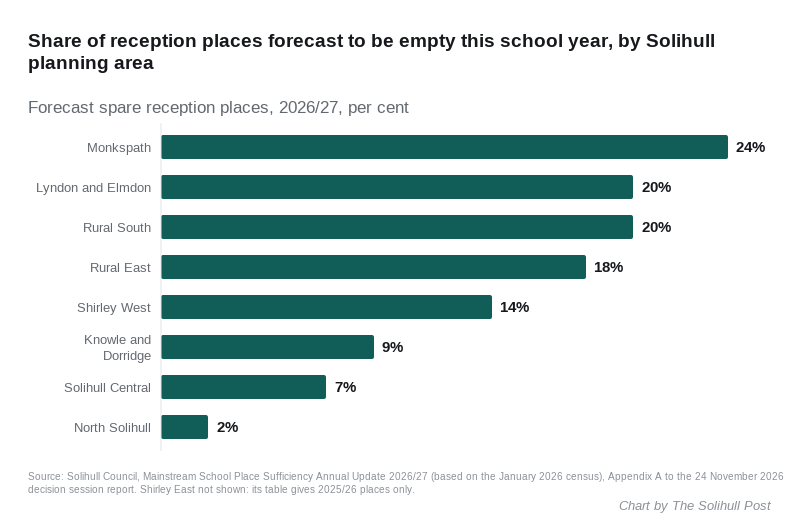
The plan splits the borough into nine primary planning areas. Spare reception places this year range from 24% in Monkspath to 2% in North Solihull. Some local details from the plan:
- Monkspath: Monkspath Primary’s intake is to drop by one class from 2027.
- Knowle and Dorridge: reception places have already been cut by 60, two classes a year. A new primary school is still planned in the longer term because of housing.
- Shirley East: one reception class has gone, and later birth figures point to smaller year groups in 2029 and 2030.
Housing still needs new schools
New primary schools are planned in the Rural South, Rural East and Knowle and Dorridge areas, tied to big housing sites. The Rural South takes in Cheswick Green, Dickens Heath, Hockley Heath and Tidbury Green. The plan counts 4,959 homes there that have outline approval or are awaiting a decision. Because of that, a second new primary school “now needs consideration”, it says.
Primary numbers in the Rural South are forecast to rise, from 1,389 pupils this year to 1,541 in 2030/31. Rural East is the only other area expected to grow, from 1,287 to 1,374.
The council counts only housing with planning permission in its forecasts. It says the draft Local Plan sites will be added once there is more certainty. That plan is out for comment until 11 December.
Secondary schools are still full
Secondary numbers peak sooner than primary. The plan says the last of the larger Year 7 groups arrives in September 2027. Whole-school secondary rolls are then forecast to fall 3.5% over seven years.
Most Solihull secondary schools still fill their Year 7 places. In January 2026, 757 Year 7 pupils (24%) lived outside the borough. The council says that leaves little room for families who move into Solihull mid-year.
In the Central and West area, extra Year 7 “bulge” classes continue until September 2027, adding 225 places in total. Langley School opens a sixth form in September 2027.
What it means for you
- Applying for a reception place for September 2027: more schools have spare places than a few years ago, but the council is cutting intakes at some of them. Check each school’s admission number for 2027 before you rank your choices. The deadline is 15 January 2027.
- Applying for Year 7: the squeeze is not over. Most Solihull secondaries still fill in the first round.
- Moving into Solihull: in-year secondary places are hard to find, the council says, and places cannot be held for families moving in.
Have your say