
Solihull Council has approved work on 154 SEND places in specialist bases at seven primary and four secondary schools. The decision takes effect on 2 December.
Solihull Council wants to open specialist classes for children with special educational needs in 11 mainstream schools, creating 154 places. The plan goes to the cabinet member for children, education and skills for a decision on Tuesday 24 November.
The places are set out in a report on specialist bases for the decision session at 6pm. The same meeting is asked to approve the council’s yearly plan for special school places, which shows demand still running well ahead of supply.
Overview
Updated 27 November: Councillor Karen Grinsell, the cabinet member, approved the plan on 24 November. Officers can now work with schools to commission and deliver the specialist bases, the printed decisions say. The decision takes effect on 2 December. The 11 schools have not been named in the decision.
Solihull Council plans 154 new places for children with education, health and care plans (EHCPs), in specialist classes at seven primary schools (80 places) and four secondary schools (74 places). Two bases, at Coleshill Heath and Windy Arbor primary schools, are already going through the formal process. It was approved on 24 November 2026 and takes effect on 2 December.
What a specialist base is
A specialist base is a small class inside a mainstream school, run with council funding. It is for pupils with an EHCP whose needs are too complex for an ordinary classroom. Solihull already has seven such units, which it calls additionally resourced provisions.
The council’s report says the new name follows the government’s February 2026 schools white paper. That paper split “inclusion bases” into two kinds:
- support bases, which schools or trusts fund themselves for short-term help
- specialist bases, which the council commissions for pupils with the most complex needs
The council’s principles for the new bases say:
- places are only for children with an EHCP that names the base
- children can join mainstream lessons where that suits them
- class sizes are set in the council’s contract with the school
- other pupils may use the base for no more than half a day a week
Which schools are involved
Two projects are already under way, both in north Solihull and both for pupils who need support with cognition and learning:
| School | Places | Where it has got to |
|---|---|---|
| Coleshill Heath Primary School | 16 (two classes of 8) | Consultation done by the Collaborative Education Trust; awaiting Department for Education regional approval, expected by January 2027 |
| Windy Arbor Primary School | 8 | Prosper Together Multi Academy Trust has started its consultation; a vacant building would be used |
The report says 11 more schools have been picked for “meaningful conversations”, chosen to spread places across the borough. It does not name them. The council’s sufficiency plan puts the numbers at:
- seven primary schools, 80 places
- four secondary schools, 74 places
The council expects to remodel spare classrooms rather than put up new buildings. Some of the money comes from the Department for Education after it decided not to go ahead with a 150-place free school for pupils with severe learning difficulties on the Sans Souci site. The rest comes from the council’s high needs capital grant.
Why the council says it needs them
The council’s plan forecasts 1,784 more Solihull children and young people with an EHCP by 2033. That is a rise of 63.6% in seven years, up from a 54% forecast a year ago.
It also shows that, in January 2026, more Solihull pupils with an EHCP were in mainstream schools (912) than in special schools (906). The plan says mainstream has overtaken special schools for the first time. In 2022 the mainstream figure was 527.
Even with the new bases and 30 more places at Reynalds Cross School, the plan forecasts a shortfall. By 2033 it expects Solihull to need 2,288 specialist places with 1,464 available in the borough, a gap of 824. That count leaves out children missing from education and young people not in education, employment or training.
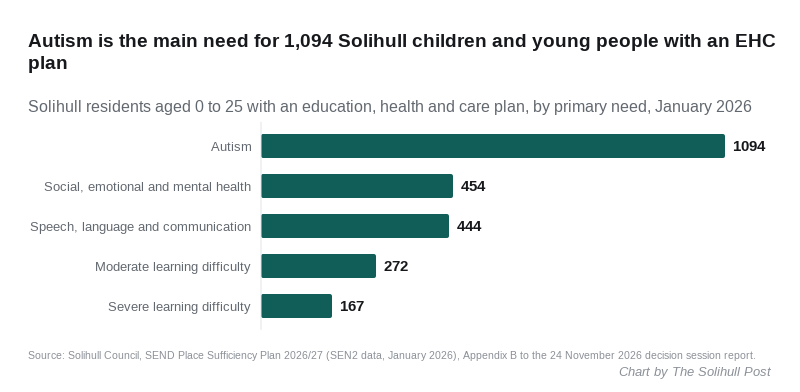
Autism is the main need for 1,094 of the borough’s children and young people with an EHCP, 39% of them. The plan puts the national figure at 33.5%. Social, emotional and mental health needs grew fastest over five years, by 82%, from 249 to 454.
What happens next
The report says each base still needs its own statutory process before it opens. For council-maintained schools the council runs that process and councillors take the decision. For academies the trust runs it under Department for Education rules. Parents and staff are consulted in both cases.
What it means for you
- If your child has an EHCP: a specialist base place is named in section F of the plan, through the council’s usual consultation with schools. Ask your SEND case officer which bases are planned near you.
- If your child’s school is one of the 11: the trust or the council must consult before any base opens, and you can respond.
- To watch the decision: the meeting papers will carry the decision record after Tuesday.
Have your say