

JLR plans a paint shop up to 35m high on the site of Lode Lane's Block 2, one of 20 projects running to 2030. The council says no environmental impact assessment is needed.
Updated 17 November: the council decided on 6 November that JLR does not need its prior approval to demolish Block 2, the body-in-white building (PL/2026/01854/PN). The Block 36 notice was still awaiting a decision on 17 November. A new full application, PL/2026/02000/PPFL, arrived on 4 November. It covers demolishing an old loading dock on the Eastworks building and a steel-framed extension to Block 63B, and is open for comments.
JLR plans to knock down the building at its Lode Lane plant where car bodies are welded together, and put up a new paint shop up to 35 metres tall in its place.
The paint shop is the largest of 20 linked projects at the Solihull site. They are set to run from this winter to 2030. JLR’s consultants WSP set them out in a screening request to Solihull Council in September.
The council replied on 9 October. Its screening opinion says the package is “unlikely to have significant environmental impacts”. JLR therefore does not need to produce a full environmental impact assessment.
That is not planning permission. Each project still needs its own application, and most are major ones.
Why JLR wants to do it
WSP’s report says the plant needs to “modernise, expand and be reconfigured”. It is building electric models alongside petrol, diesel and hybrid ones. JLR plans a pure electric model for each of its brands by 2030, the report says.
The council’s opinion describes the 20 projects as supporting electric vehicle manufacturing at the site.
What would be built
The main changes, from WSP’s report and its floorspace comparison:
- Block 2 demolished. The Body in White building, where bodies are assembled, covers 65,333 square metres.
- A new paint shop on the Block 2 footprint, up to 163,000 square metres including mezzanine floors. It would be 29.75 metres to the parapet and about 35 metres at the tallest stack.
- A painted body store of 6,179 square metres, 32 metres high, linked to other buildings by conveyor bridges.
- The south car park double-decked, with up to 72,000 square metres over three levels and a maximum height of 10 metres.
- A contractors’ compound of up to 10,000 square metres for the paint shop build.
- The “deep south” buildings demolished: 11,000 square metres of storage, workshops, offices and utilities.
- Smaller schemes, including a 2,750 square metre modular office for 100 staff, a relocated canteen, a 90-space car park and a new internal road.
Across the 19 projects with floorspace figures, 78,853 square metres would be demolished. The total would rise from 231,953 to 326,868 square metres, an increase of 94,916.
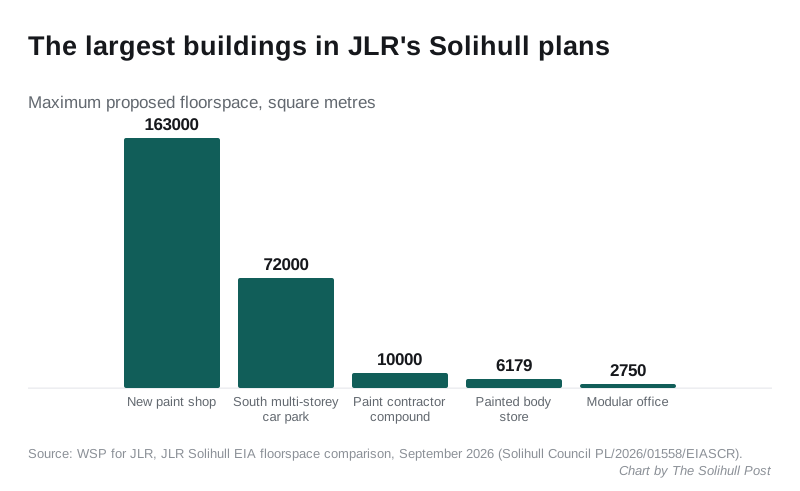
The new paint shop would run alongside the existing one for one to two years before the old one closes, WSP says.
When it would happen
WSP’s programme puts the work in seven phases. The main dates:
| What | When, according to JLR’s programme |
|---|---|
| Demolition of Block 2, Block 36 and teardown building | April 2027 to January 2028 |
| Temporary 116-space staff car park | January 2027 to July 2028 |
| Paint shop application submitted | May 2027 |
| Paint shop construction starts | November 2027 |
| Peak of construction lorries | March to June 2028 |
| Painted body store working | August 2029 |
| Construction ends | 2030 |
Demolition and building work would run from 8am to 6pm, Monday to Friday, the report says.
Two applications are already on the council’s register. A prior notification to demolish Block 2 (PL/2026/01854/PN) arrived on 13 October. A second, for Block 36 (PL/2026/01925/PN), a storage building, followed on 23 October. Both were awaiting a decision on 3 November. Block 2 has since been cleared: the council said on 6 November that prior approval was not required.
Jobs and traffic
The report expects about 300 construction jobs. It says there will be no increase in permanent jobs and no extra staff parking.
During the build:
- lorries would peak at about 56 a day for four months, from March to June 2028
- contractors would make up to 497 two-way car trips a day at the March 2028 peak, outside rush hours
- contractors would park on the top deck of JLR’s logistics centre and come in by minibus
Once finished, JLR says the plant would send about 38 fewer two-way lorry movements a day onto local roads. Conveyor bridges between buildings would replace about 905 lorry trips a day inside the site, the report says.
What it means for you
- If you live south of the plant, the paint shop would sit on the existing Block 2 footprint and would not come any closer to homes, WSP says. Houses there are screened by a bund. Each application is to carry its own noise survey.
- You can comment on each application as it is lodged. The Block 2 and Block 36 notices are open for comments on the council’s planning register; search for “Jaguar Land Rover Lode Lane”. Our Solihull planning news page tracks other big schemes.
- If you work at JLR, this does not create permanent jobs, according to the report. Our earlier story covers support and rights if your job is at risk.
- Expect more construction traffic from 2027, peaking in spring 2028. Most of it is planned outside rush hours.
Sources: Solihull Council screening opinion, PL/2026/01558/EIASCR, 9 October 2026; WSP screening request for JLR, September 2026; WSP floorspace comparison; application record.
Have your say