
Solihull's SEND plan reaches scrutiny on 8 September. Approval this month would clear £33.9m of a £37.7m schools deficit. EHC plans are up 12% to 2,805.
Up to £33.9 million of Solihull Council’s schools debt could be written off this month, if the Secretary of State approves the SEND plan the council submitted to the Department for Education in June.
The papers going to the Resources and Delivering Value Scrutiny Board on Tuesday 8 September set out how much is riding on that decision. Solihull’s published cumulative Dedicated Schools Grant deficit for 2025/26 was £37.7 million. The High Needs Stability Grant would clear up to 90% of it. (Solihull Council report, 8 September 2026)
Even in the best case, the council is left with what the report calls “a minimum £3.8 million one-off pressure” to find. If the plan is not approved this month, Solihull gets nothing in this round and has to improve it and resubmit.
The numbers behind the deficit
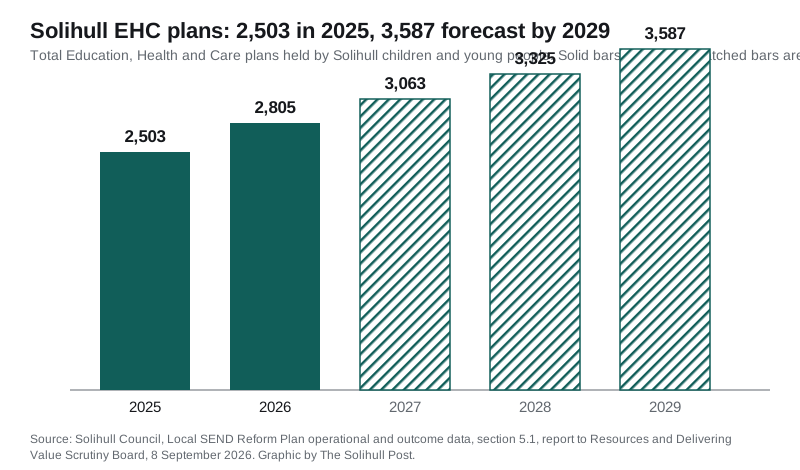
The council’s own figures show why the debt keeps growing. The number of children and young people in Solihull with an Education, Health and Care plan rose from 2,503 in 2025 to 2,805 in 2026, a rise of 12% in a year. The council forecasts 3,587 by 2029.
Behind that total, three needs are driving almost all of the growth between 2025 and 2026:
- autism, from 937 plans to 1,115, up 19%
- social, emotional and mental health, from 379 to 451, up 19%
- speech, language and communication needs, from 410 to 432, up 5%
The cost differences between placements are stark. In 2025/26 the council’s average annual cost per child was £7,900 in a mainstream school, £12,800 in a maintained special school, and £71,800 in a non-maintained special or independent school. Solihull funded 167 independent placements in 2025 and 200 in 2026, and forecasts 245 by 2029. (Local SEND Reform Plan operational and outcome data)
Spending on the high needs block was £53.1 million in 2024/25 and £57.9 million in 2025/26. SEN home-to-school transport is forecast to jump 38% this year, from £6.5 million to £8.9 million.
The forecast is already out of date
Two things in the papers are worth flagging.
First, the financial forecasts submitted to the DfE assume 2,700 EHC plans in 2026. The council’s own data in the same pack puts the January 2026 figure at 2,805. The document flags this itself: “Actual SEN2 is higher than anticipated.” It says the financial impact of the real January 2026 data “will be updated and submitted in a future return.”
Second, the council’s July budget monitoring, going to the same meeting, reports the Dedicated Schools Grant forecasting an adverse variance of £14.958 million this year. The report says the 90% grant is deliberately not built into forecasts “until there is more certainty on the position”. (Medium Term Financial Strategy update at Period 4)
What the plan actually promises
The plan runs for three years and covers changes the government says do not need new legislation. The report is clear that no SEND legislation and no EHC plans will change before 2029. What Solihull has committed to includes:
- piloting one support base in a primary school and one in a secondary school during the 2026/27 school year
- support bases in 14 secondary schools, 10 primary schools and Solihull College by 2029, with the schools not yet chosen
- one new specialist base, what Solihull currently calls an Additional Resource Provision, in a primary school in the north of the borough in 2026/27
- 200 specialist base places in mainstream schools over three years
- an “Experts at Hand” offer from September 2026 giving schools access to educational psychologists, speech and language therapists, occupational therapists and specialist teachers, with special school outreach from January 2027
Solihull’s transformation grant for 2026/27 is £2,049,792, and the plan for the year has been built inside that. (Summary of the local area reform plan)
Families were not consulted on it
The DfE gave every local area 14 weeks to produce its plan and a deadline of 19 June. The report says that timetable had a cost. Officers worked with schools, colleges, health partners and two parent carer groups, Solihull Parent Carer Voice and Our Voices Heard, “but no wider consultation was able to take place with children and families”.
The report adds that families were responding to the national SEND consultation at the same time as the local plan was being written, and that the outcome of the national consultation “will not be known until later in the year”.
The council describes the plan as a working document that will keep changing, with the DfE having already issued fresh guidance in late June that has to be worked into the next version by September.
What it means for you
If your child has an EHC plan, nothing changes about that plan this year. The legal framework stays as it is until at least 2029, and this plan does not alter anyone’s entitlement.
What it does change is where support is meant to sit. The direction is more specialist provision inside ordinary Solihull schools and fewer children travelling out of the borough to independent placements. That is why the council is putting bases into 24 schools and the college, and why the transport bill matters.
If you want to hear it debated, the Resources and Delivering Value Scrutiny Board meets at 6pm on Tuesday 8 September in the Civic Suite, and is webcast. Questions and deputations are the third item on the agenda. (Agenda)
For advice on your own child’s support, the council’s Solihull Local Offer is the starting point.
Related: Solihull GCSE results 2026 and what to do next, and how the council’s money is raised in our guide to Solihull council tax bands.
Have your say