
The council published no borough figures. Here is the West Midlands picture, the free drop-ins on 25 and 26 August, and the 24 September deadline to challenge a mark.
Solihull’s GCSE results arrived on Thursday, and the council’s statement about them contains no numbers at all.
The Leader of the council, Councillor Karen Grinsell, said the results “reflect the hard work they have put into their studies” and pointed anyone disappointed towards the council’s Skills for Success team. No borough pass rate, no grade 7 share, no school-level figures. (Solihull Council, 20 August 2026)
There is a reason for that, and it is not evasiveness. Ofqual does not publish GCSE results by local authority in its statistics. Its data tables go down to region and centre type only. So this piece does what the figures actually allow: the regional picture, the reason school percentages are not comparable, and the three dated things a Solihull family can act on in the next five weeks.
The regional picture
Ofqual issued 5,720,045 GCSE results to 1,047,750 students in England on 20 August. Nationally, 21.8% were graded 7 or above, a fraction up on 2025, and 67.0% were graded 4 or above, a fraction down. (Ofqual, Qualification results in England: summer 2026)
The West Midlands sits at the bottom of the regional table on grade 4 and above, as it has in each of the last four years.
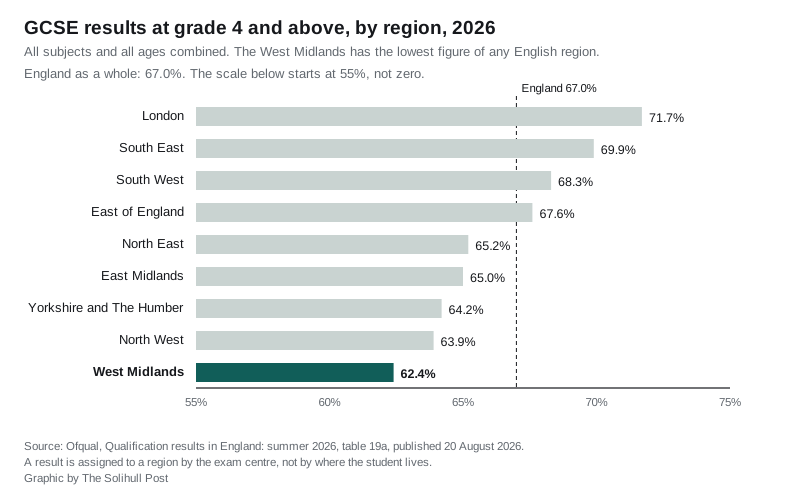
- West Midlands, all ages: 62.4% at grade 4 and above, 18.3% at grade 7 and above. Both slightly down on 2025.
- West Midlands, 16 year olds only: 66.6% and 19.7%. Restricting the count to 16 year olds lifts every region, because it strips out the resit entries.
- London, all ages: 71.7% and 28.6%, a gap of more than nine percentage points on grade 4 and above.
One caveat matters for reading any of this locally. Ofqual assigns a result to a region using the exam centre, not the student’s home address. A borough on a boundary, with students crossing it in both directions, is not neatly captured by its region’s number.
Why one school’s percentage cannot be set against another’s
Every year, schools publish results in whichever form flatters them: 9 to 7, 9 to 4, “including equivalents”, sometimes with vocational qualifications folded in. Ofqual’s own table shows how far apart the starting points are before any of that begins.
| Type of centre | Grade 7 and above | Grade 4 and above |
|---|---|---|
| Grammar schools | 63.2% | 97.4% |
| Independent and private schools | 47.1% | 88.4% |
| Local authority maintained comprehensives | 20.1% | 68.6% |
| Free schools | 21.7% | 68.2% |
| Academies | 19.7% | 68.2% |
| Secondary modern schools | 16.8% | 64.9% |
| Sixth form colleges | 3.9% | 32.2% |
| Further education establishments | 1.3% | 17.6% |
| All state-funded | 20.6% | 66.1% |
Source: Ofqual data tables, table 20, England, 2026, all subjects and all ages.
The bottom two rows are not failing institutions. Colleges and FE providers enter large numbers of students resitting English and maths, so their pass rates measure something completely different from a school’s Year 11 cohort. The fair comparison for any Solihull school is its own figure last year, and the line in Ofqual’s table for its own type of centre.
If you want a grade checked
This is the deadline most families miss, and it is five weeks away.
For GCSEs, both post-results services close on Thursday 24 September 2026. (JCQ post-results services)
- Clerical re-check, a check that every question was marked and the marks added correctly. Completed within 10 calendar days of the awarding body receiving the request.
- Review of marking, where a senior examiner reviews the marking itself. Completed within 20 calendar days.
Three things that catch people out:
- The request goes through the school or college, not the student or parent. Contact the exams officer, not the exam board.
- Written consent from the student is required before a centre can request a review of marking.
- There is no grade protection. A review can lower a grade as well as raise it, and the new mark stands.
The priority service, with its 20 August deadline, applies to A levels, AS levels and Level 3 vocational qualifications only. It is not available for GCSEs.
If you did not get a grade 4 in English or maths
The November resit series runs in the first full week of the month. On the Pearson Edexcel timetable, GCSE English Language papers fall on Tuesday 3 and Thursday 5 November, and GCSE Mathematics papers on Wednesday 4, Friday 6 and Monday 9 November, all morning sessions. (Pearson Edexcel November 2026 GCSE timetable, final)
Other boards sit their papers in the same window. Entries are made by a school or college acting as the exam centre, so anyone planning to resit needs to raise it with their new sixth form or college in the first days of term rather than in October.
The free drop-ins, in the next fortnight
Solihull Council’s Skills for Success team is running application support drop-ins for students in school years 11 to 13. No booking is mentioned for the drop-in sessions themselves, and the dates below come from the council’s own summer workshop flyer. (Solihull Council, Skills for Success summer workshops)
- Tuesday 25 August, 9.30 to 11.30am and 1.30 to 3.30pm, Room 4, Civic Suite, B91 9SE
- Wednesday 26 August, 9.30 to 11.30am, Riverside Family Hub, B37 5DP
- Wednesday 26 August, 1.30 to 3.30pm, Elmwood Place Family Hub, B36 0UG
- Tuesday 1 September, 9.30 to 11.30am, Room 4, Civic Suite, B91 9SE
- Wednesday 2 September, 9.30 to 11.30am, Riverside Family Hub, B37 5DP
- Wednesday 2 September, 1.30 to 3.30pm, Elmwood Place Family Hub, B36 0UG
The team’s email address is skillsforsuccess@solihull.gov.uk. The sessions cover applications to college, apprenticeships and university, one to one.
What it means for you
You can leave school on the last Friday in June if you turn 16 by the end of the summer holidays. You cannot then do nothing. Until you are 18 you have to be in one of three things: full-time education, an apprenticeship, or 20 hours or more a week of work or volunteering combined with part-time education or training. (GOV.UK)
That third option is the one people forget exists, and it is the reason a missed college place in August is not the end of the year.
It also matters more here than it did two years ago. Claims for out-of-work benefits by 18 to 24 year olds in Solihull have risen 30% in that time, the steepest rise of the seven West Midlands metropolitan boroughs, while claims by every older group have held flat or fallen. We set out those figures, ward by ward, in our report on the borough’s claimant count.
Sources
- Solihull Council, Solihull students celebrate outstanding GCSE results, 20 August 2026
- Ofqual, Qualification results in England: summer 2026, tables 19a, 19b and 20
- JCQ, post-results services, summer 2026
- Pearson Edexcel, November 2026 GCSE examination timetable, final
- Solihull Council, Skills for Success summer workshop flyer
- GOV.UK, Know when you can leave school
Have your say