
Solihull's own Cabinet report says its section 151 officer may have to consider a Section 114 notice for 2027/28. July's overspend is £1.48m on a £244m budget.
Solihull Council has put the words “Section 114” into a public budget report, and set out in writing what would trigger one.
The report went to Cabinet on 17 September and was approved. Most of it is routine monitoring. One paragraph is not (report, PDF).
What the report actually says
There is already “a significant funding shortfall” in both 2027/28 and 2028/29, the report says. Setting a balanced budget for 2027/28 is described as “the minimum legal responsibility for the Council”, and it will need “difficult decisions made by all Members on agreeing where savings can be made”.
Then the conditional sentence. If enough savings cannot be found and agreed, and if Exceptional Financial Support from government “is no longer deemed a viable option or is rejected”, then the section 151 officer “would be in the position of having to consider issuing a Section 114 notice”.
Two things are worth being clear about. This is not a notice, and it is not a prediction. It is the council naming the conditions under which its own finance chief would have to consider one. Councils do not usually spell that out in a routine monitoring report.
The section 151 officer at Solihull is the Director of Resources, Andy Felton.
What a Section 114 notice would mean
The report explains it, which is itself unusual. A Section 114 notice is a formal public statement that a council cannot balance its budget. Once one is issued, the council cannot incur new spending unless the section 151 officer permits it, and its leadership has to meet within 21 days to bring spending into line with funding.
The report lists four ways that is normally done:
- deeper cuts to services
- a government “capitalisation direction”, letting the council spend capital budgets on day to day costs
- a council tax rise above the referendum limit, which government has allowed for some authorities in this position
- intervention from central government, including the appointment of a commissioner
This year is not the problem
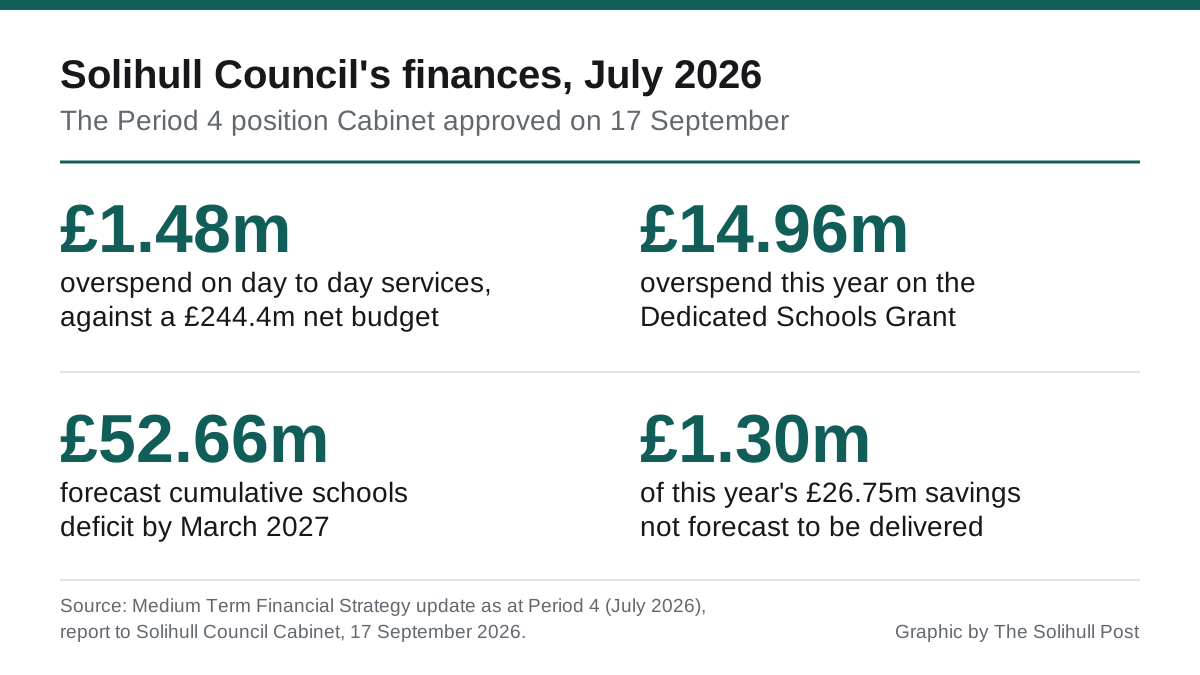
The in-year position is comparatively small. At the end of July the council was forecasting an overspend of £1.480 million against a net budget of £244.357 million, which is 0.61%.
It has also been improving. The forecast at Period 3 was £2.868 million, so it came down by £1.388 million in a month. Cabinet was told the position “remained manageable” and was expected to improve further through spending controls.
The pressures inside that figure are the familiar ones:
- Adult Social Care, £513,000 over. Older people’s care is £1.256 million over on its own, adults with disabilities £457,000 and mental health £446,000, partly offset elsewhere.
- Resources, £451,000 over. Housing benefit subsidy is £608,000 adverse. Dividend income from Birmingham Airport is forecast £455,000 lower, which the report attributes to the impact of conflict in the Middle East.
- Corporate items, £722,000 over. That includes a £344,000 business rates deficit, £351,000 because the pay award proposal came in higher than budgeted, and £423,000 against a Digital and AI savings target.
- Children’s Services, £220,000 over.
- Economy and Infrastructure, £418,000 under, helped by homelessness grant funding and lower waste disposal costs.
The capital programme is forecast £238,000 underspent.
The number that dwarfs all of that is the schools deficit
The Dedicated Schools Grant is forecasting an overspend of £14.958 million this year. On the council’s own figures the cumulative schools deficit reaches £52.656 million by the end of 2026/27.
Solihull has submitted a SEND Reform Plan to the Department for Education and is waiting to hear whether it gets the High Needs Stability Grant, which would clear up to 90% of the deficit built up to the end of 2025/26. That money is deliberately excluded from the forecasts until there is more certainty. We covered what is riding on that decision in Solihull SEND: £33.9m debt write-off rests on this month.
The statutory override that keeps these deficits off the main accounts runs out on 31 March 2028.
Savings are mostly landing, but not all of them
The council set itself £26.748 million of savings for this year. £25.449 million is forecast to be delivered, leaving £1.299 million short.
The largest single gap is £1 million in Resources, where two property services savings will not be delivered as originally planned. The report says the service will find the money by other means.
What Cabinet was told on the night
The decision record is blunter than the report in places (decision record).
The Chief Executive told members that issuing a Section 114 notice did not alter the underlying financial challenges facing a council. It represented a choice, Cabinet was told, between addressing those challenges internally or having external intervention. Members were also told that another independent review of the council’s financial management arrangements is taking place, and that the feedback would be shared in due course.
The Director of Resources clarified that any application for Exceptional Financial Support would require the support of Cabinet only, and agreed to explore whether there is any potential group litigation over underfunding from government.
The dates that matter
The budget for 2027/28 is built between now and February. The report sets out the timetable:
- July to September 2026: officers work up pressures, mitigations and savings options
- October 2026: all-member briefing on the position
- October 2026 to January 2027: councillors develop proposals with officers
- February 2027: the budget goes through scrutiny boards, Cabinet and full council
Two other things were approved in the same report. A £438,000 capital receipt from selling four-year-old vehicles used on the Strategic Environment Contract goes towards their replacements. And £500,000 from Housing Revenue Account working balances is being spent on getting ready for the revised social housing consumer standards, ahead of a housing inspection the council expects within the next 18 months.
The corporate risk attached to delivering the medium term financial strategy is recorded at net level 20.
What it means for you
- Nothing changes this month. No Section 114 notice has been issued and the council is not forecasting one. The report sets out the conditions under which its finance chief would have to consider it.
- The decisions that matter come this winter. The all-member briefing is in October and the budget is set in February 2027. That is the window in which service cuts or a higher council tax would be agreed.
- Council tax is part of the picture. A referendum-busting rise is one of the four routes the report lists after a Section 114 notice. Current charges are on our Solihull council tax bands page.
- The schools deficit is the swing factor. A government decision on the High Needs Stability Grant is worth up to £33.9 million to Solihull and is not in any of these forecasts.
- The accounts are close to signed off. The draft 2025/26 statement of accounts was published on 29 June and the external audit was expected to be substantially complete during September.
Sources
- Medium Term Financial Strategy (MTFS) update as at P4 (July 2026), report to Cabinet, PDF, Solihull Council, 17 September 2026, for the Section 114 passage, the budget timetable, the vehicle receipt and the HRA allocation.
- Appendix A, detailed financial summary, PDF, for the directorate variances, the £52.656m cumulative schools deficit and the capital forecast.
- Appendix B, savings summary, PDF, for the £26.748m savings target and the £1.299m shortfall.
- Decision: Medium Term Financial Strategy (MTFS) update as at P4 (July 2026), Solihull Council Cabinet, 17 September 2026, published 18 September 2026, for what members were told at the meeting.
Have your say